
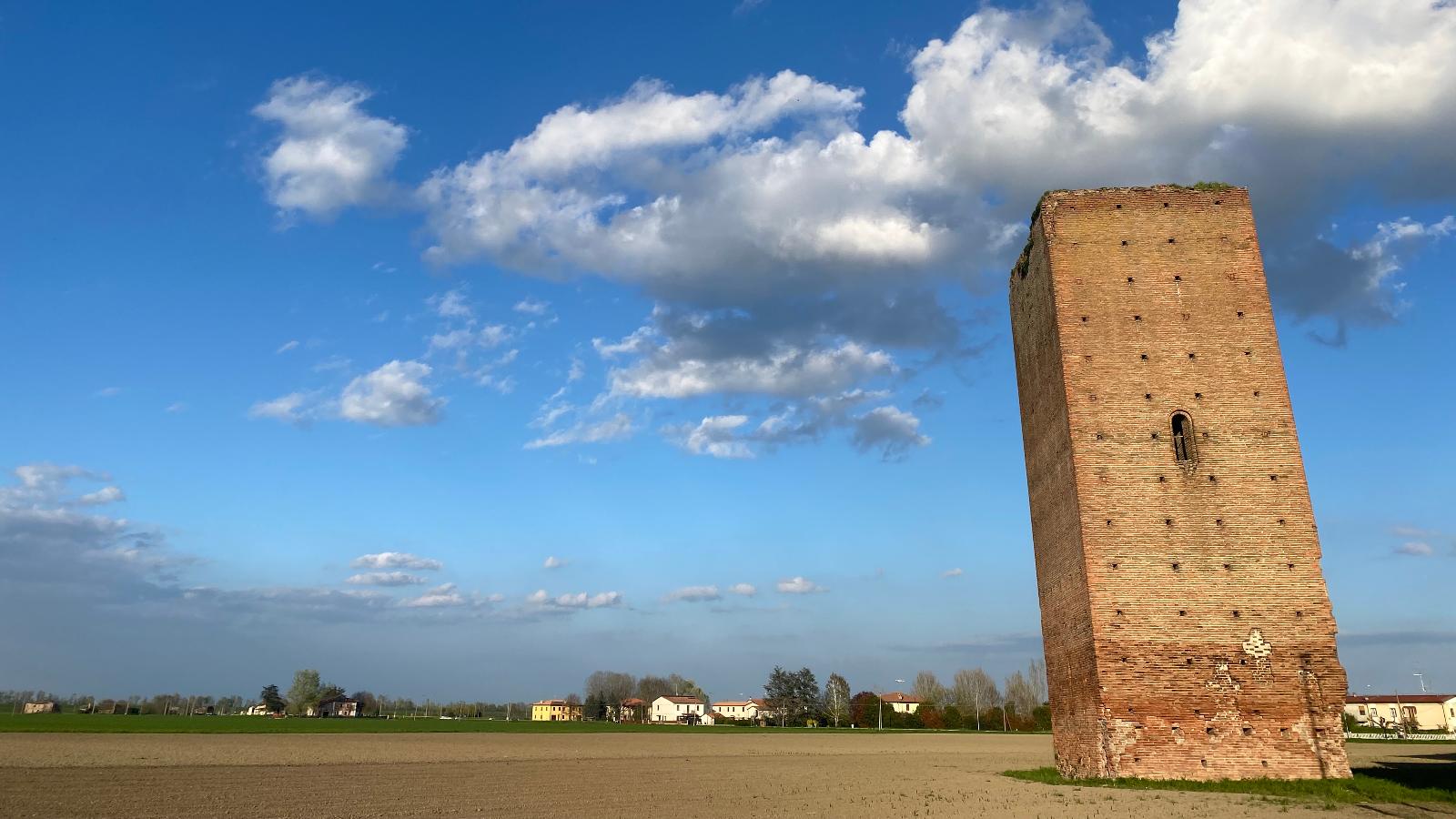
The Tower of Galliera was probably built at the end of the 12th century, and its appearance recalls that of the city towers of Bologna. In particular, one can notice a strong resemblance to the Garisenda Tower and the Galuzzi Tower, with which it shares various architectural details, though not the construction technique (the Galuzzi Tower is built using a “sack” technique, while the Galliera Tower has solid masonry walls—an unusual feature in the Bolognese context). Its base dimensions are remarkable, measuring approximately 9.30 by 7.50 meters, and originally it must have reached a total height of about 30 meters.
A characteristic element of Bolognese towers is the elevated entrance, which in the Tower of Galliera is located on the southern side and features typical selenite blocks along with an arch decorated in terracotta. Another characteristic element of Bolognese towers—and more generally of many medieval buildings—is the putlog holes, used to support scaffolding for construction and later maintenance. In the Tower of Galliera, five rows can be identified on the northern and southern sides, and four on the other two sides.
From Danti’s drawing, one can observe how the base is depicted, highlighting its inclination and a clear separation from the body of the tower. This element, together with the presence of selenite blocks at the entrance, may suggest that the base was originally sloped and at least partially covered with selenite blocks. However, recent analyses show that, unlike other Bolognese towers, the Tower of Galliera does not have a selenite base; instead, the entire load-bearing structure is made of masonry. Another feature visible in Danti’s drawing is the roof, no longer present for at least a couple of centuries, but once again linking it to the Galuzzi Tower.
Four floors can be identified in the tower, in addition to the attic level. The ground floor, currently buried, is believed to have had no openings to the outside and to have been accessible only from the floor above. The latter is characterized by the elevated entrance and, on the opposite side, by a loophole with a rather elaborate structure.
Externally, the first floor featured a wooden gallery running along three sides of the tower, supported by beams whose holes are still visible near the doorway and along the relevant sides. The first floor was accessed via a removable wooden ladder that could be easily taken away in case of danger. The second floor can be recognized externally by a window on the western side and internally by a slight narrowing of the wall, which made it easier to insert a wooden floor. The third floor is identifiable by a loophole on the eastern side and, internally, by a further reduction in wall thickness. It is worth noting that the loophole on this level is much simpler internally than the one on the first floor.
Finally, the attic was the uppermost level, located just below the top of the tower. This was the only true vantage point from which the surrounding territory could be observed, allowing control over the movement of goods and early detection of potential dangers. From here it was also possible to communicate with other towers that characterized this border area with the Este domains. This defensive system relied on a precise code of signals: nighttime optical signals (fires), daytime signals (smoke), and acoustic signals (first bells, later bombards).
The tower also shows traces of a later building attached to it, identified as the podesteria in Danti’s drawing. In particular, on the southern and eastern sides there are holes of different sizes and positions compared to the putlog holes; these were used for the beams of the floors and roof of the podesteria. The arch of the doorway also bears damage caused by the “necessity” of inserting one of these beams precisely at that point.
Text by Simone Boselli
Photo by Giulia Ventura
Map
Galliera medieval tower
Via Barchetta
40015 Galliera
Entrance
| Full | € 5,00 |
| Reduced | € 2,00 |
Interests
- Art & Culture
Insights
The headquarters of the Pro-Loco Galliera (via Dante Alighieri 3, San Vincenzo di Galliera) opened on 1st Tuesday of the month, at 9,00pm-10,30pm